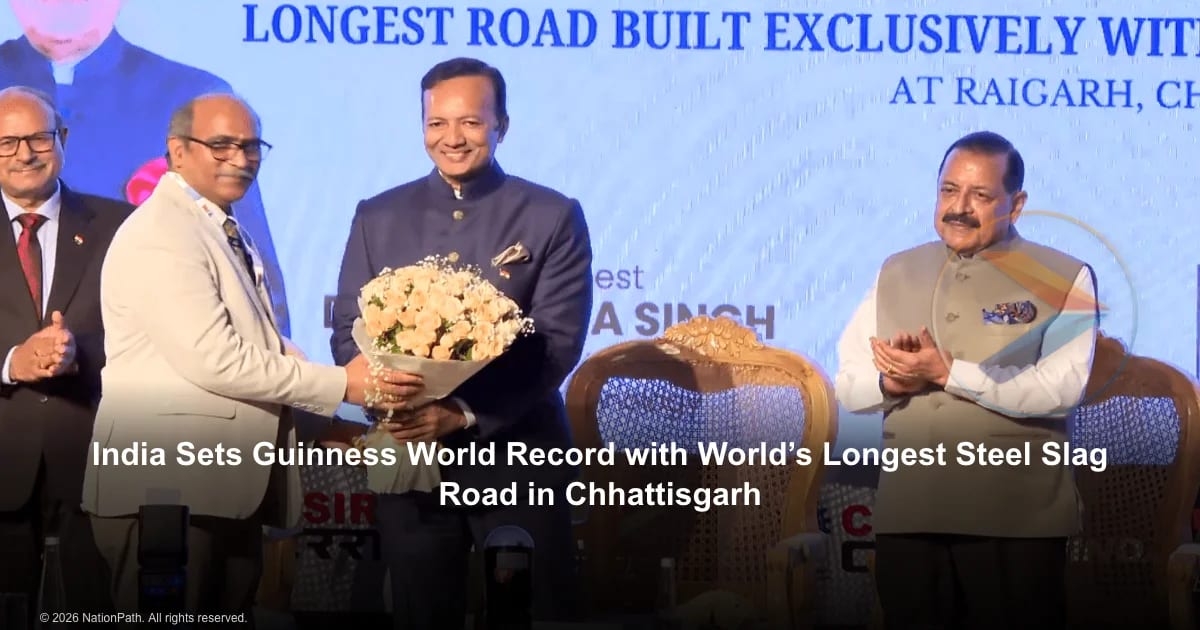

India has achieved a Guinness World Records title for the “World’s Longest Road Built with Processed Steel Slag Aggregates” at Raigarh in Chhattisgarh. The road is 1.85 kilometres long and was developed through a collaboration between Jindal Steel Limited and CSIR-Central Road Research Institute (CSIR-CRRI).
The four-lane divided road uses approximately 200,000 tonnes of processed electric arc furnace (EAF) steel slag. The processed slag was subjected to controlled ageing and stabilisation, metal recovery, crushing, screening, grading and quality checks before being used in the pavement. Project information states that the material underwent physical, mechanical, geotechnical and environmental testing.
Editorial Insight
Key Highlights
Important points readers should notice.
Guinness World Records title: World’s Longest Road Built with Processed Steel Slag Aggregates.
Location: Raigarh, Chhattisgarh.
Road length: 1.85 kilometres.
Steel slag used: Approximately 200,000 tonnes of processed EAF steel slag.
Cost saving: Project information estimates savings of up to 40%; Dr Jitendra Singh separately cited around 40% potential cost reduction.
Strength claim: Dr Jitendra Singh said the technology can deliver four times the strength of conventional roads.
According to project information, processed steel slag was used across the pavement structure, enabling 100% replacement of natural aggregates and saving approximately 200,000 tonnes of virgin stone. The pavement is reported to be approximately 35% thinner, with estimated construction-cost savings of up to 40%.
Speaking at the Guinness World Records conferment ceremony in New Delhi, Union Minister of State (Independent Charge) for Science and Technology Dr Jitendra Singh said Steel Slag Road Technology can reduce road-construction costs by around 40% while delivering four times the strength of conventional roads. These figures are retained as statements made by the minister and are not presented as independent measurements in this article.
Dr Singh also said the technology can substantially extend the maintenance cycle, with maintenance required only after about 15 years in suitable applications. He called for the indigenous technology to move from one project to multiple projects and from one state to several states, including applications by Railways, government departments, state governments and private infrastructure operators.
Editorial Analysis
Why This Matters
The Raigarh project demonstrates the large-scale use of processed steel slag as a road-construction aggregate. By replacing natural aggregates with processed industrial by-products, the technology has the potential to reduce dependence on quarrying and create a productive use for steel-industry slag. The project is also significant for the wider adoption of indigenous road-construction technology developed with CSIR-CRRI and industry participation. Its long-term benefits will depend on performance across different road conditions and on technically suitable applications.
The project is being presented as an example of the “Waste to Wealth” approach, as it converts steel production slag into an engineered construction material. The project team also launched SteelGrit, Jindal Steel’s brand of processed steel slag aggregates.
A Technology Transfer Agreement was also signed between CSIR-CRRI and Jindal Steel to facilitate wider adoption of the technology beyond the Raigarh project.