
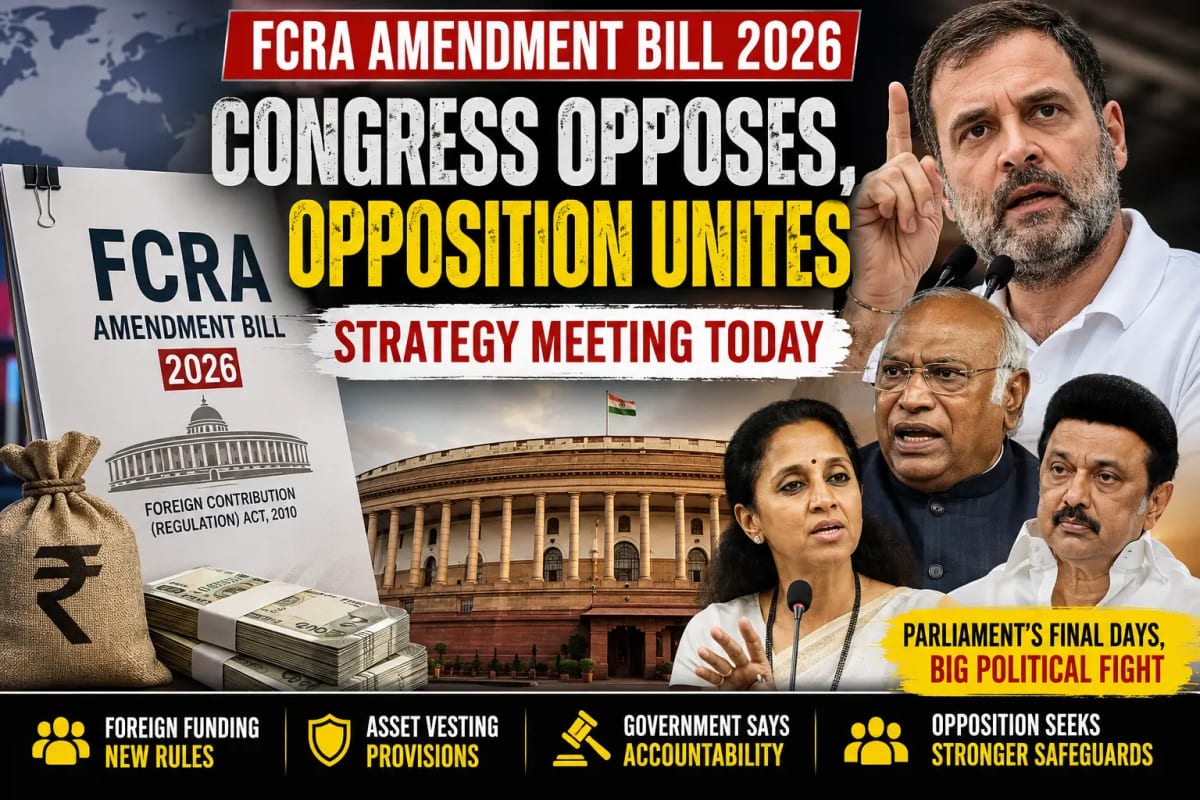

The proposed Foreign Contribution (Regulation) Amendment Bill, 2026 is heading into a politically significant phase as Congress and other Opposition parties prepare to coordinate their stand against the legislation.
Congress announced on August 9 that it would oppose the Bill, with Opposition floor leaders scheduled to discuss their strategy on August 10. K.C. Venugopal has also indicated strong resistance from Congress and other Opposition parties.
Editorial Insight
Key Highlights
Important points readers should notice.
FCRA Amendment Bill, 2026 was introduced in Lok Sabha on March 25, 2026. Congress announced its opposition on August 9.
Opposition floor leaders are scheduled to discuss their strategy on August 10. Rahul Gandhi has raised concerns over the proposed changes, according to Congress-published material.
NCP (SP) and DMK have also expressed opposition. The Bill proposes a Designated Authority for foreign-funded assets.
Assets could be provisionally vested when an FCRA certificate ceases. Assets could be returned if registration is restored or renewed within the prescribed period.
Permanent vesting could follow if restoration does not take place. The proposal also includes provisions for public use or disposal of permanently vested assets.
The Bill, introduced in the Lok Sabha on March 25, 2026, seeks to amend the Foreign Contribution (Regulation) Act, 2010 and establish a more detailed framework for foreign-funded assets when an organisation's FCRA certificate ceases to operate.
The issue has gained wider political significance as NCP (SP), DMK and other Opposition voices have also raised concerns over the proposed changes.
What Does the Bill Propose?
Editorial Analysis
Why This Matters
The FCRA Bill could significantly change how foreign-funded assets are regulated when an organisation's registration ceases. The debate is therefore important for both government accountability and safeguards for NGOs and other organisations receiving foreign contributions.
One of the most significant proposed changes concerns assets created from foreign contributions.
Under the proposed framework, such assets could initially be vested provisionally with a Designated Authority when an organisation's FCRA registration ceases.
If the organisation's registration is renewed, restored or a fresh certificate is granted within the prescribed period, the assets and unused foreign contribution could be returned.
If restoration does not take place within the prescribed period, the provisional vesting could become permanent under the proposed framework.
The proposal also includes a framework for the disposal or public use of assets that become permanently vested.
Other proposed changes include provisions relating to organisations operating under prior permission, compliance and administrative procedures, and a reduction in the maximum imprisonment for certain FCRA violations from five years to one year.
Government's Position
The Centre has presented the proposed amendments primarily as a governance and accountability measure.
The government says the existing framework under Section 15 of the FCRA can create difficulties when registrations cease and assets created from foreign contributions remain in administrative custody for extended periods.
The proposed system is intended to provide a time-bound process covering provisional vesting, restoration and, where necessary, permanent vesting and lawful disposal.
The government has also highlighted safeguards. It says assets can be returned when registration is restored within the prescribed period, while permanently vested assets would be used for public purposes. Places of worship would retain their religious character, and orders of the Designated Authority would be subject to revision and judicial appeal.
The government has further clarified that cessation of FCRA registration should not automatically be interpreted as proof of fraud or criminal wrongdoing because registration can cease for several reasons, including expiry, surrender, refusal of renewal or cancellation under the law.
Why Is the Opposition Objecting?
The Opposition's main concern is the extent of regulatory control that could arise when an organisation's FCRA certificate ceases.
A key policy concern relates to the proposed vesting of foreign-funded assets with the Designated Authority.
PRS Legislative Research has also flagged questions around the absence of an appeal mechanism when the Central Government denies renewal of an FCRA certificate.
The government, however, maintains that the proposed framework contains restoration provisions and judicial remedies and is intended to address gaps in the existing system rather than provide arbitrary control over organisations.
The broader disagreement therefore centres on the balance between foreign-funding accountability, regulatory oversight and organisational autonomy.
Rahul Gandhi and Congress Position
Congress has opposed the proposed FCRA changes and has raised concerns over their possible impact on NGOs and civil-society organisations.
Congress-published material also records concerns raised by Rahul Gandhi regarding the proposed changes and their potential impact on NGOs.
The Opposition's argument is centred on safeguards, regulatory powers and the consequences for organisations whose FCRA registration is cancelled, surrendered or not renewed.
Existing FCRA Framework
The Foreign Contribution (Regulation) Act, 2010 regulates the acceptance and utilisation of foreign contributions in India. Organisations receiving foreign contributions generally require FCRA registration or prior permission. Registration is subject to renewal, and the government can cancel registration under specified circumstances.
The existing law also contains provisions dealing with foreign-funded assets when an FCRA registration is cancelled or surrendered. The proposed 2026 Bill seeks to create a clearer and more time-bound mechanism around those assets.
Political Significance
The FCRA dispute comes during the final days of Parliament's Monsoon Session, giving the proposed legislation an immediate political significance. For the government, the Bill is primarily about creating a clearer framework for foreign-funded assets, improving compliance and addressing gaps under the existing law.
For the Opposition, the central question is how much control the government should have over organisations receiving foreign contributions and what safeguards should apply when registration is cancelled, surrendered or not renewed. With Congress, NCP (SP), DMK and other Opposition voices raising concerns, the issue extends beyond a single-party protest and could become part of wider Opposition coordination in Parliament.
Legal & Policy Concern
The proposed Designated Authority mechanism is central to the Bill. While the government says the framework would provide a time-bound process and judicial remedies, PRS has raised questions around asset vesting and the availability of an appeal mechanism in cases where the Central Government denies renewal.
The policy debate therefore goes beyond foreign contributions themselves and extends to who controls foreign-funded assets, when that control begins and what legal remedies organisations have.


