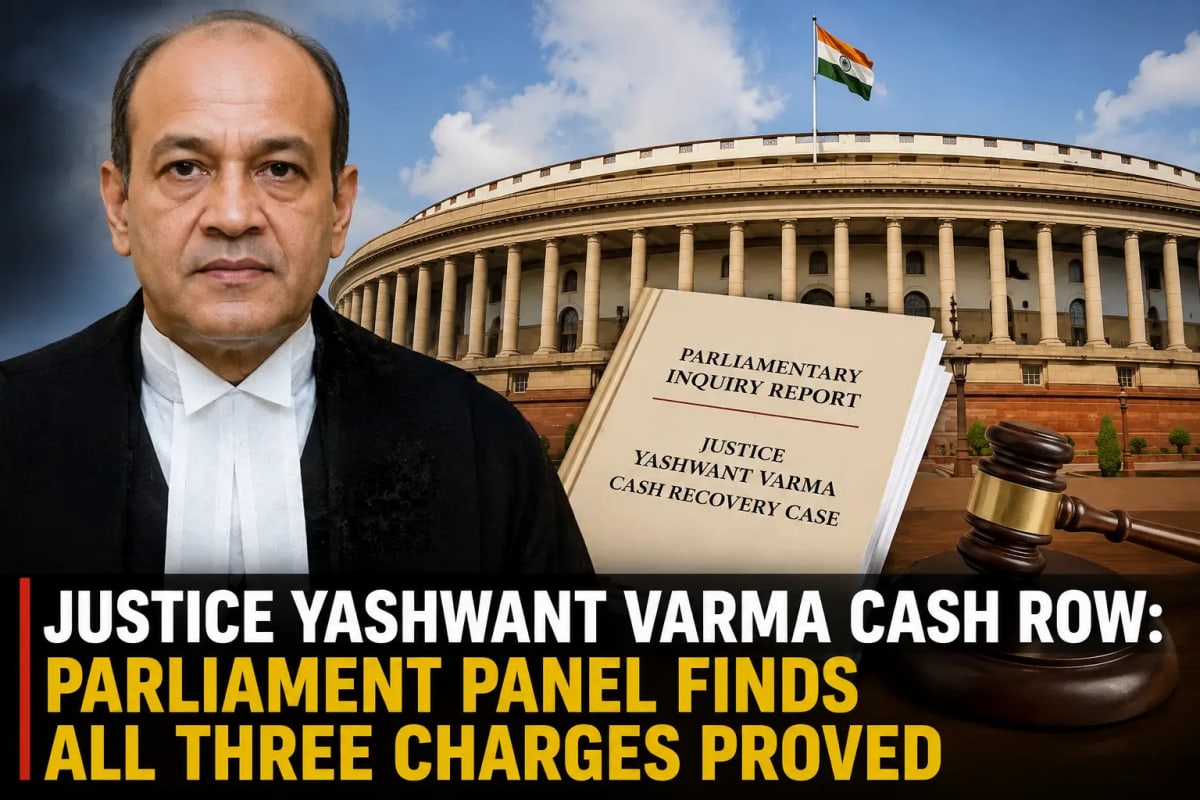

The inquiry into the controversial cash-recovery case involving former judge Justice Yashwant Varma reached a significant stage on Wednesday after a three-member parliamentary inquiry committee found all three charges against him proved.
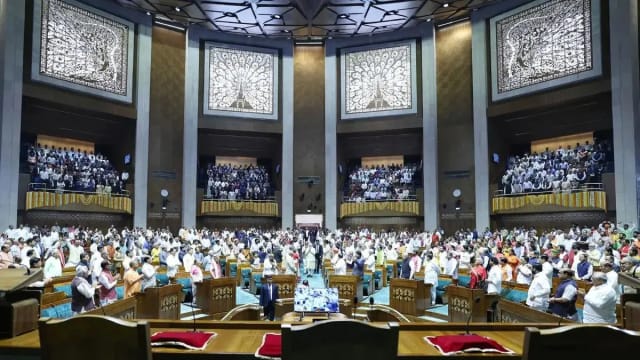
The inquiry report was tabled in the Lok Sabha, placing the findings formally before Parliament.
Editorial Insight
Key Highlights
Important points readers should notice.
Parliament's inquiry committee found all three charges against Justice Yashwant Varma proved. The report was tabled in the Lok Sabha on August 12, 2026.
The case originated with the discovery of burnt and partially burnt currency after a fire at his official residence in March 2025.
The committee examined the unexplained cash, handling of material evidence and Justice Varma's explanations.
The committee found his explanations unsatisfactory. Justice Varma has denied knowledge of the cash and wrongdoing.
He resigned from judicial office in April 2026. The latest report brings the parliamentary inquiry to a major conclusion.
The case dates back to March 2025, when a fire at Justice Varma's official residence in New Delhi led to the discovery of burnt and partially burnt currency notes in a storeroom.The discovery triggered an internal judicial inquiry and subsequently a statutory inquiry under the Judges (Inquiry) Act, 1968.
The parliamentary committee's findings now state that the charges against Justice Varma stand proved. The three charges relate broadly to the presence and possession of unexplained Indian currency notes at the official premises, failure to preserve or prevent interference with material evidence, and the furnishing of evasive or misleading explanations during the inquiry.
What Did the Committee Find?
Editorial Analysis
Why This Matters
The Justice Yashwant Varma case has become one of the most closely watched judicial-accountability controversies in recent years. The significance lies in the institutional questions it raises: How should allegations against judges be investigated? How should evidence involving members of the higher judiciary be handled? And what mechanisms should Parliament use when a judicial inquiry finds serious misconduct? The latest committee finding provides Parliament with a formal conclusion on the charges. For the judiciary, however, the larger issue is public trust. The credibility of courts depends not only on judgments delivered in courtrooms but also on confidence that judges themselves are subject to appropriate standards of accountability.
The committee's findings centre on three principal allegations.
First, it found that substantial unexplained currency notes were discovered within the official premises associated with Justice Varma.
Second, the committee found that material evidence connected with the cash discovery was not properly preserved and that there was interference with the evidence.
Third, the committee concluded that Justice Varma's explanations during the inquiry were evasive, incomplete and unsatisfactory.
The findings are significant because the inquiry was not simply examining whether cash was discovered after the fire. It was also examining questions surrounding the handling of the material evidence and Justice Varma's explanations regarding the circumstances.
How the Case Began
The controversy emerged after a fire broke out at Justice Varma's official residence in New Delhi during the night of March 14-15, 2025.
Firefighters and other officials responding to the incident reported seeing burnt and partially burnt currency notes in a storeroom. The discovery raised questions about the source and ownership of the cash and whether the judge had any connection with it. Justice Varma denied knowledge of the cash and maintained that he and his family had no connection with the money.
The controversy subsequently led to an in-house judicial inquiry.
Parliamentary Inquiry
After the issue moved into the parliamentary process, Lok Sabha Speaker Om Birla constituted a three-member Judges Inquiry Committee in August 2025 to examine the charges. The committee was tasked with examining the allegations and the material available in the case. The inquiry eventually submitted its report to the Lok Sabha Speaker in May 2026.
The report was subsequently taken up for parliamentary consideration and was tabled in the Lok Sabha on August 12.
Justice Varma's Position
Justice Yashwant Varma has denied wrongdoing in relation to the cash discovery.
His defence has included the position that he was not present in Delhi when the incident occurred and that the storeroom where the cash was allegedly discovered was not a part of the residential area routinely used by him and his family.
He has also disputed responsibility for the cash and questioned the circumstances surrounding its discovery.
The parliamentary committee, however, did not accept his explanations as satisfactory and has now recorded that the relevant charges were proved.
Why the Report Is Important
The case has implications beyond one former judge.
The judiciary depends heavily on public confidence, institutional integrity and accountability. Allegations involving a serving or former judge therefore carry consequences for the credibility of the judicial institution itself.
The committee's conclusion that all three charges were proved gives Parliament a formal finding on the allegations and moves the matter into its next constitutional and parliamentary phase.
At the same time, the committee's finding should be distinguished from a conventional criminal conviction. The report arises from a parliamentary judicial-misconduct inquiry, and any subsequent action must follow the applicable constitutional and parliamentary procedure.