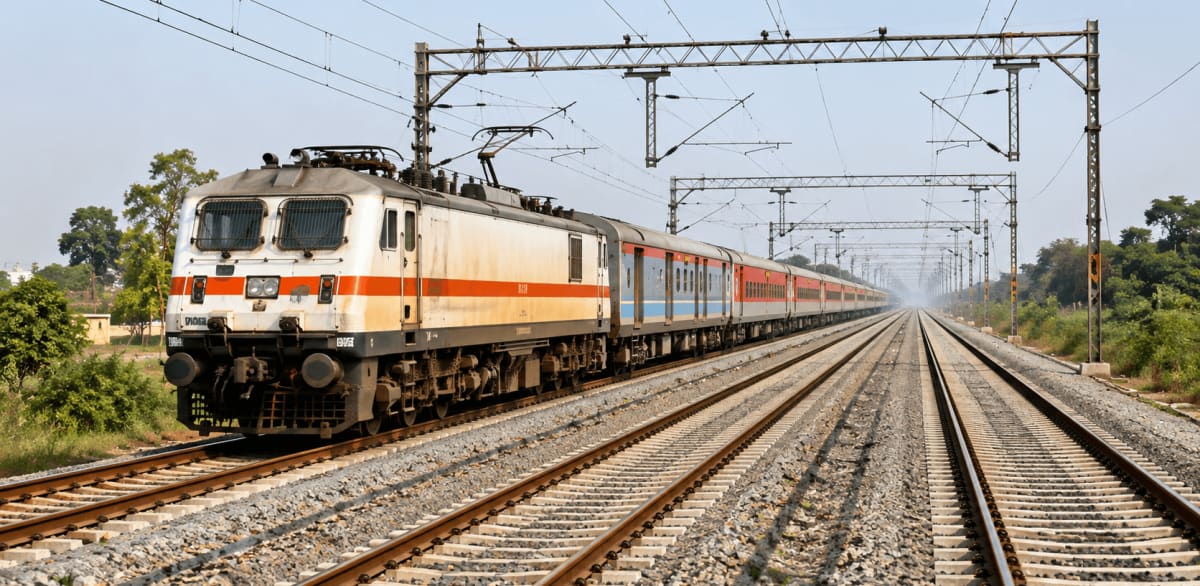

The Cabinet Committee on Economic Affairs, chaired by Prime Minister Narendra Modi, on Wednesday approved four railway multitracking projects with a total estimated cost of ₹9,450 crore.
The projects will cover eight districts across West Bengal, Odisha, Andhra Pradesh and Tamil Nadu and add approximately 410 km to the existing Indian Railways network. They are scheduled to be completed by 2030-31.
Editorial Insight
Key Highlights
Important points readers should notice.
Four railway multitracking projects approved.
Estimated cost: ₹9,450 crore.
Approximately 410 km of additional railway network.
Projects span West Bengal, Odisha, Andhra Pradesh and Tamil Nadu. Eight districts will be covered.
Around 6,448 villages and approximately 60 lakh people are expected to benefit.
Projects are planned under the PM Gati Shakti National Master Plan.
The approved projects include the 173-km Kharagpur-Bhadrak (Ranital) fourth line, the 75-km Bhadrak-Haridaspur fourth line, the 90-km Gummidipundi-Gudur third and fourth lines, and the 72-km Cuttack-Paradeep (Badabandha) third and fourth lines.
The additional track capacity is expected to help ease congestion, improve train operations and strengthen the movement of both passengers and freight on these routes. The projects have been planned under the PM Gati Shakti National Master Plan, with an emphasis on integrated planning, multimodal connectivity and logistics efficiency.
According to the government, the projects are expected to improve rail connectivity for approximately 6,448 villages with a combined population of around 60 lakh. The routes are also important for transporting commodities such as coal, iron ore, cement, steel, containers, automobiles and food grains.
Editorial Analysis
Why This Matters
The projects are expected to expand rail capacity on routes carrying substantial passenger and freight traffic. Increased capacity can help reduce congestion and improve the movement of goods, including coal, iron ore, cement, steel, containers, automobiles and food grains. The projects are also expected to strengthen connectivity to several economic and tourist destinations along the routes.
The Railways estimates that the additional capacity could facilitate around 76 million tonnes per annum (MTPA) of additional freight traffic. The government has also projected savings in oil consumption and reductions in carbon emissions as a result of the capacity expansion.