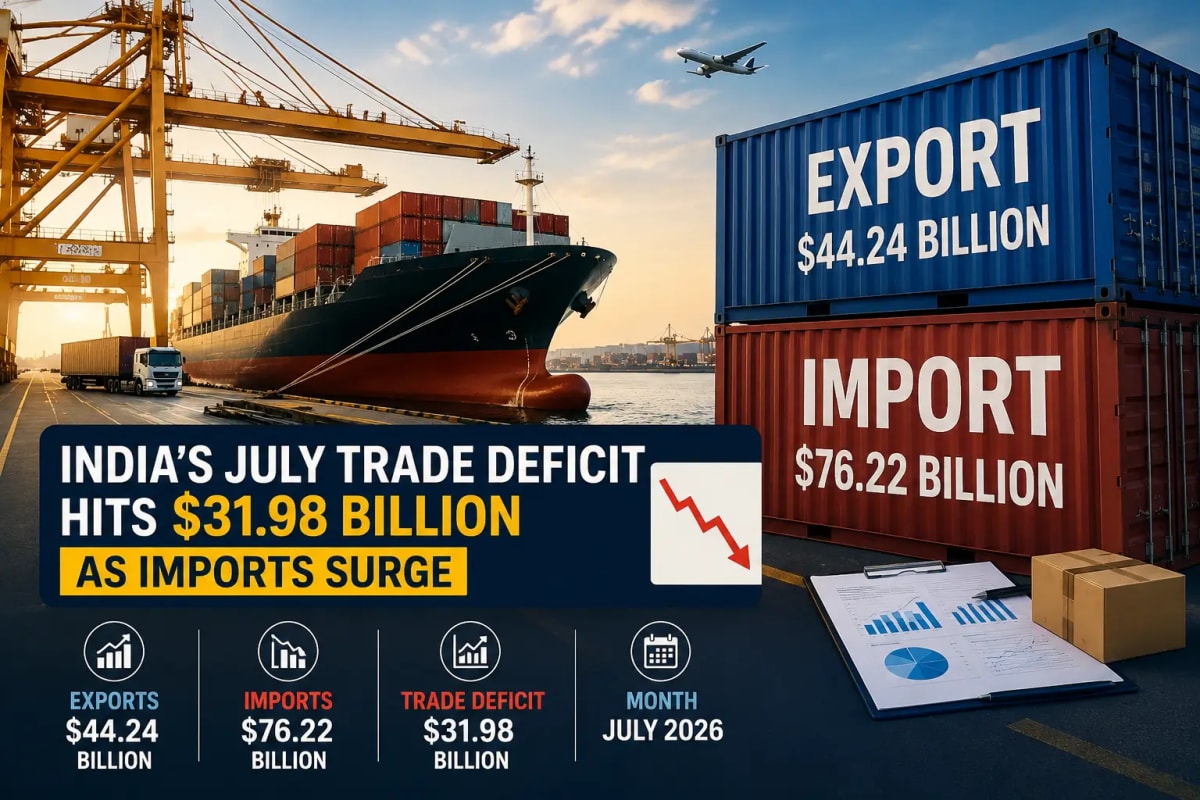

India’s merchandise trade deficit widened sharply in July, reaching $31.98 billion, as a stronger rise in imports outweighed a significant increase in exports.
According to data released by the Ministry of Commerce and Industry, merchandise exports rose 19.63% year-on-year to $44.24 billion in July, while merchandise imports increased 17.52% to $76.22 billion. The resulting trade deficit was the highest in six months. The July export number is particularly significant because $44.24 billion represents a record for the month of July. Export growth was supported by petroleum products, electronic goods, engineering goods and other manufacturing-linked sectors.
Editorial Insight
Key Highlights
Important points readers should notice.
India’s July merchandise trade deficit reached $31.98 billion. It was the highest merchandise trade deficit in six months. Merchandise exports rose 19.63% to $44.24 billion.
July exports reached a record level for the month. Merchandise imports rose 17.52% to $76.22 billion. Petroleum product exports jumped 67.64%.
Electronic goods exports increased 57.40%. Engineering goods exports rose 17.71%. India's exports to the Middle East increased 8.6% year-on-year.
The United States remained India's largest export destination. April-July merchandise exports reached $173.78 billion.
April-July merchandise imports stood at $292.38 billion. The April-July merchandise trade deficit reached $118.60 billion.
However, the country's import bill remained substantially higher than its export earnings. Imports of goods climbed to their highest level in nine months, creating a wider gap between what India sold overseas and what it purchased from international markets.
Higher global energy and freight costs have added pressure to India's import bill. The continuing conflict and disruption in West Asia have affected shipping conditions and energy markets, making the external trade environment more challenging for import-dependent economies such as India. Crude oil remains an important part of this equation. Reuters reported that India's oil import bill stood at around $18.31 billion in July, with higher global prices keeping the cost elevated despite a marginal decline in the volume of oil imports.
At the same time, India's export performance provides a more positive side to the numbers. Petroleum product exports increased 67.64% year-on-year to $6.92 billion, while electronic goods exports rose 57.40% to $5.92 billion. Engineering goods exports also increased to $12.24 billion, up 17.71% from a year earlier.
Editorial Analysis
Why This Matters
The July data shows both strength and pressure: India's exports are growing strongly, but imports are still rising fast enough to widen the goods trade gap. West Asia-related energy and shipping risks make the import side particularly important for the months ahead.
The electronics number is particularly important for India's changing export profile. The strong rise indicates that manufacturing-linked exports are becoming an increasingly visible part of India's overseas trade performance.
Exports to West Asia also showed resilience despite the regional conflict. Reuters reported that India's exports to the Middle East rose 8.6% year-on-year in July, while the United States remained India's largest export destination.
The services sector provides another cushion. India's estimated services exports helped keep the overall external trade picture stronger than the merchandise numbers alone suggest. For April-July 2026-27, total exports of goods and services were estimated at $316.42 billion, up 13.16% from the corresponding period a year earlier. For the first four months of the financial year, merchandise exports reached $173.78 billion, compared with $148.48 billion during April-July 2025-26. Merchandise imports, however, rose more sharply to $292.38 billion, leaving a cumulative merchandise trade deficit of $118.60 billion.
The July numbers therefore present a mixed picture for India's economy. Exports are showing strong momentum, particularly in electronics, engineering and petroleum products, but the country's import requirement remains large enough to widen the merchandise trade gap.
For policymakers, the challenge will be to sustain export growth while reducing vulnerability to external shocks, particularly energy prices, shipping disruptions and geopolitical tensions.