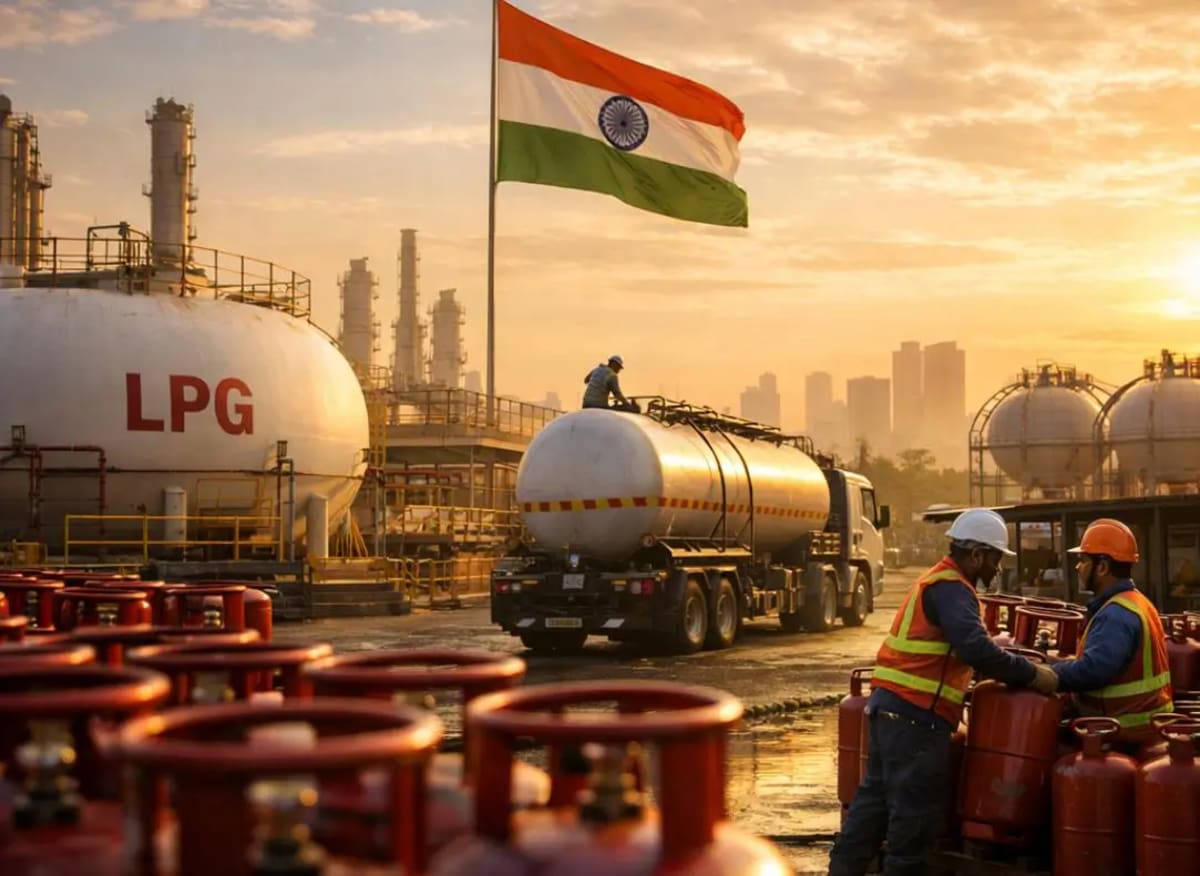

The Indian government has taken a major step to strengthen domestic LPG supplies after disruptions in international energy markets exposed the country's dependence on imported cooking gas.
Under a government order issued on August 13, maximum daily LPG production targets have been fixed for individual public- and private-sector refineries and upstream companies. The combined production potential under the new framework is 63,810 tonnes of LPG per day. The targets are designed to provide a domestic supply buffer during periods of disruption. The production limits will come into effect when there is a supply constraint, giving the government a mechanism to increase domestic availability when imports face difficulties. The move comes against the backdrop of continuing disruption to energy supplies linked to the West Asia conflict. India relies significantly on imports to meet its LPG requirement, making international shipping routes and overseas availability important for the country's cooking-fuel supply.
Editorial Insight
Key Highlights
Important points readers should notice.
Centre has fixed maximum LPG production targets for individual refineries and upstream companies. The framework covers 21 refineries and upstream companies.
Combined production potential has been set at 63,810 tonnes per day. Targets will apply when supply constraints arise.
Reliance Industries has received the largest individual target of 18,000 tonnes per day. India consumed around 33.2 million tonnes of LPG in FY2025-26.
Domestic production was around 13.1 million tonnes. Around 21.3 million tonnes was imported during the same period.
India had around 331.4 million active domestic LPG connections as of July 1, 2026. The move aims to strengthen India's energy security amid geopolitical disruptions.
Data cited in reports based on the government order shows that India consumed around 33.2 million tonnes of LPG during the 2025-26 financial year, equivalent to roughly 91,000 tonnes a day. Domestic production during that period was about 13.1 million tonnes a year, or around 35,900 tonnes a day. Imports accounted for approximately 21.3 million tonnes, or about 58,400 tonnes a day. The numbers highlight the scale of India's import dependence. Domestic production covered only a portion of total consumption, while a much larger volume came from international supplies. Among the companies covered by the new production framework, Reliance Industries has received the largest individual target. Its older refinery has been assigned a maximum production level of up to 18,000 tonnes of LPG per day, according to the government order. The government's approach is aimed at creating additional resilience rather than depending entirely on overseas supplies during a crisis. The development also follows earlier government measures to protect LPG availability after the Middle East conflict disrupted supply routes. India had previously directed refiners to maximise LPG production during the supply crisis. For ordinary households, LPG availability is particularly important because cooking gas remains one of the country's most widely used household fuels. Government data shows that India had around 331.4 million active domestic LPG connections as of July 1, 2026, underlining the scale of the system that needs to be supplied.
The new framework therefore represents more than a refinery-level production decision. It is part of a broader effort to build a stronger domestic energy buffer and reduce the vulnerability of essential fuel supplies to geopolitical shocks.
The government has also been working to diversify LPG sourcing. Reuters reported in July that India had accelerated purchases from the United States and other suppliers as Middle East disruptions affected imports.
Editorial Analysis
Why This Matters
India's LPG story is directly connected to household kitchens and energy security. With millions of domestic connections and a large import requirement, disruption in international supplies can quickly become a domestic concern. The new framework gives the government an additional tool to respond before an external energy shock turns into a wider supply problem.
The latest production targets give India another layer of protection: instead of relying only on additional imports during a crisis, domestic refiners can be called upon to increase LPG output when supply conditions require it.