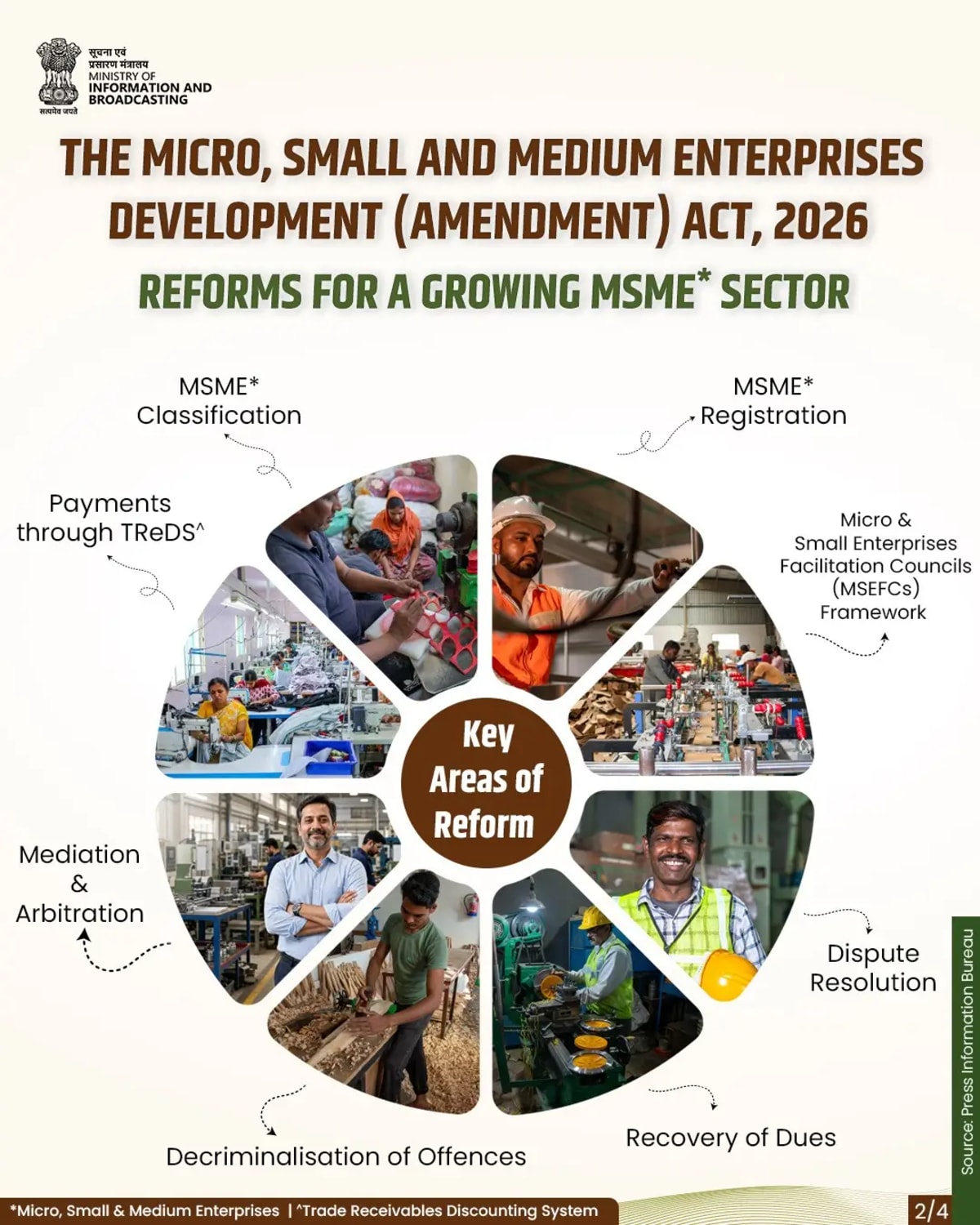

India has strengthened the legal framework governing micro, small and medium enterprises with the MSME Development (Amendment) Act, 2026, aimed at making it easier for businesses to grow while addressing one of their biggest challenges — delayed payments.
The amendment updates the MSMED Act, 2006 and introduces changes covering MSME registration, invoice settlement, dispute resolution and enforcement. The Bill was passed by the Rajya Sabha on August 3 and by the Lok Sabha on August 7.
Editorial Insight
Key Highlights
Important points readers should notice.
MSME registration moves towards a digital, voluntary framework.
TReDS gets a stronger role in MSME invoice settlement.
Delayed-payment disputes get a clearer adjudication and appeal mechanism.
The Development Commissioner will serve as the adjudicating officer.
Penalties will be subject to periodic increases. The amendment updates the MSME legal framework established in 2006.
One of the significant changes is the move towards digital and voluntary MSME registration, allowing enterprises to file their memorandum through notified national or State digital platforms.
The amendment also strengthens the mechanism for dealing with delayed payments. For covered transactions, TReDS — the Trade Receivables Discounting System — becomes an important route for settling MSME invoices, bringing payment processes into a more formal digital framework.
The changes come against the backdrop of persistent payment delays faced by smaller businesses. The government has previously identified delayed payments as a major problem because they lock up working capital and can restrict an MSME's ability to expand.
Editorial Analysis
Why This Matters
For a small business, an unpaid invoice is not just an accounting issue — it can mean less money available for salaries, raw materials, expansion or the next order. By strengthening digital invoice settlement and dispute mechanisms, the amendment attempts to address that working-capital pressure while bringing greater accountability into the MSME payment ecosystem.
The amendment further provides for adjudication and appeals, with the Development Commissioner appointed as adjudicating officer and appeals lying before the MSME Secretary.
The law also introduces stronger enforcement provisions, including penalties that increase by 10 per cent of the minimum amount every three years after the commencement of the Amendment Act.