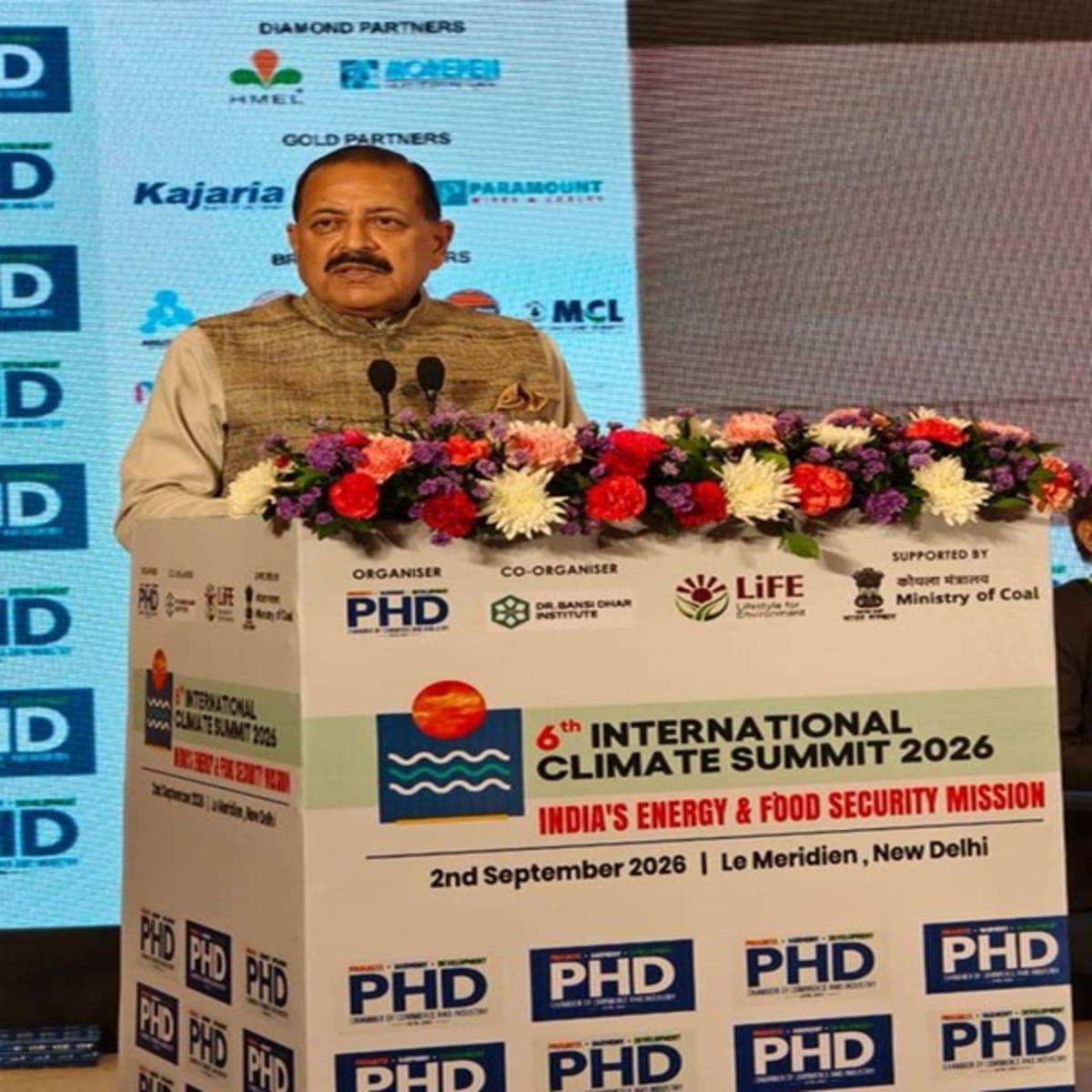

Union Minister Dr. Jitendra Singh said that energy security is inseparable from national security, strategic autonomy and economic resilience. He made the remarks while addressing the 6th International Climate Summit 2026 – India’s Energy & Food Security Mission, organised by the PHD Chamber of Commerce and Industry in New Delhi.
Dr. Singh said that amid geopolitical uncertainties, disrupted supply chains and volatile energy markets, India needs to become increasingly self-reliant, indigenous, affordable and technology-advanced in the energy sector. He stressed that technological advancement and self-reliance are closely linked, while affordability is important to ensure that emerging technologies deliver their full benefits.
Editorial Insight
Key Highlights
Important points readers should notice.
Dr. Jitendra Singh linked energy security with national security, strategic autonomy and economic resilience.
He called for an increasingly self-reliant, indigenous, affordable and technology-advanced energy sector.
Nuclear energy was identified as an important pathway for India's energy security.
India's Nuclear Energy Mission has a target of 100 GW by 2047.
The Minister referred to a target of five Small Modular Reactors by 2033.
Biofuels, ethanol, sustainable fuels and the circular economy were highlighted as components of the clean-energy transition.
The Minister described the present period as a transition towards a secure and sustainable energy future, including a shift towards clean energy. He said that as India seeks a greater global role, it must also keep pace with global trends and technological developments in the energy sector.
Highlighting a multi-pathway approach to energy security, Dr. Singh identified nuclear energy as an important area. He referred to the Nuclear Energy Mission's target of achieving 100 GW of nuclear power capacity by 2047 and described the opening of the nuclear sector to private participation as a significant development.
Dr. Singh also referred to the target of developing five Small Modular Reactors by 2033. He said such technologies are expected to become increasingly important in the years ahead and also highlighted ongoing efforts in green hydrogen, including the recently flagged-off green hydrogen train.
Editorial Analysis
Why This Matters
India's energy requirements are increasing across sectors including agriculture, transport, fertiliser and other essential economic activities. The emphasis on domestic technological capabilities, affordability and multiple energy pathways reflects an approach aimed at strengthening energy security while supporting the transition towards cleaner energy.
The Minister emphasised that biofuels and the circular economy would form an important part of India's clean-energy transition. He also pointed to biofuels, ethanol and sustainable fuels as emerging technology pathways that could contribute to the next phase of industrial development.
He stressed that India's growing energy requirements in areas such as agriculture, health, irrigation, fertiliser and transport make it necessary to accelerate the development and adoption of clean-energy technologies.
Dr. Singh said India's energy transition cannot be viewed in isolation and would require simultaneous progress in technology, self-reliance, affordability, clean energy, private participation and innovation. He also called upon industry and professional bodies to act as a bridge between the government and the non-government sector and contribute to India's development journey towards 2047.