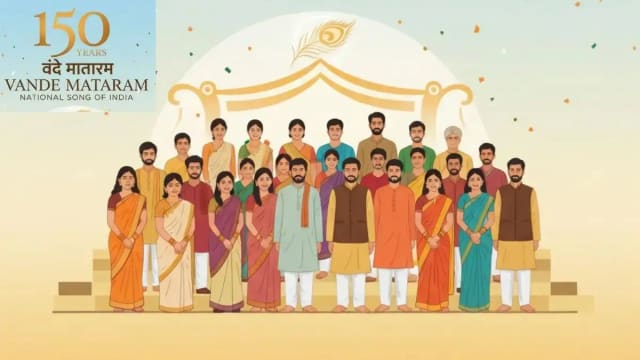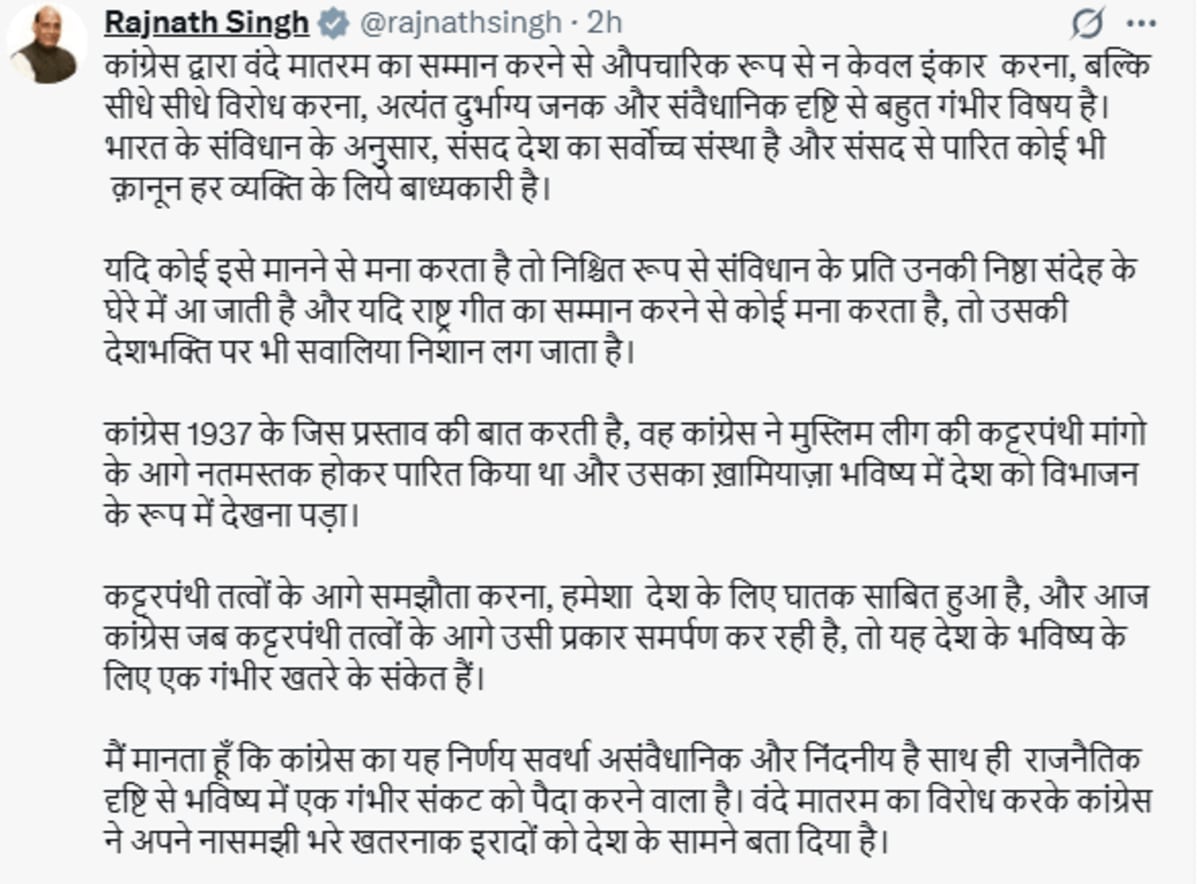

Defence Minister Rajnath Singh has launched a strong political attack on the Congress over its position on Vande Mataram, describing the party's reported stand as deeply unfortunate and raising questions about its constitutional and political implications.
Singh argued that respect for the National Song carries significance beyond party politics and said that refusing to honour it should be viewed seriously.
Editorial Insight
Key Highlights
Important points readers should notice.
Rajnath Singh criticised the Congress over its position on Vande Mataram. He described the reported stand as “unconstitutional and condemnable.”
Singh questioned the Congress's reliance on its 1937 resolution. He linked the historical controversy to wider political consequences.
The Congress has said it will follow its earlier position of singing the first two stanzas.
BJP leaders have intensified criticism of the Congress over the issue.
The dispute has developed into a wider debate over nationalism, history and political identity.
He also challenged the Congress's reference to its 1937 resolution concerning the rendition of Vande Mataram. Singh alleged that the decision taken at that time reflected a compromise made under pressure from the Muslim League and argued that such political compromises had serious historical consequences.
The Defence Minister linked the present controversy with the larger political debate over how Vande Mataram should be treated at Congress programmes. His remarks come amid a widening political dispute after the Congress Working Committee decided to follow its historical position of singing the first two stanzas of Vande Mataram at party events. The decision has triggered strong criticism from BJP leaders, who have accused Congress of disrespecting the National Song.
Singh further argued that political parties must remain conscious of the constitutional and national significance attached to symbols associated with India's freedom movement.
Editorial Analysis
Why This Matters
The controversy is significant because Vande Mataram occupies a unique place in India's political and constitutional history. The current disagreement is no longer limited to the number of stanzas performed at party events. It has become a political debate over how national symbols should be interpreted, respected and represented by political organisations. Rajnath Singh's intervention adds weight to the BJP's criticism and indicates that the issue is likely to remain politically active.
He described the Congress position as “unconstitutional and condemnable” and warned that, in his view, the issue could create wider political consequences. The remarks add another senior BJP voice to a controversy that has increasingly moved beyond the question of how the song should be performed and into a broader debate over history, nationalism, political identity and constitutional values.